What Is OSHA Class III Asbestos Work?
What Is OSHA Class III Asbestos Work?
What Is OSHA Class III Asbestos Work?
A maintenance task can look small and still fall under the OSHA asbestos construction standard. Drilling through wallboard, replacing a damaged floor tile, repairing insulated pipe or opening a ceiling for electrical work may disturb asbestos containing material. When the purpose of the job is maintenance or repair rather than full removal, the activity may qualify as Class III asbestos work.
The classification matters because it determines the training, controls and supervision expected before work begins. Calling a task routine maintenance does not remove those duties.
Class III Work Is Maintenance and Repair Work
OSHA defines Class III asbestos work as repair and maintenance operations where asbestos containing material, including thermal system insulation and surfacing material, is likely to be disturbed. The key word is disturbed. The employee may not be hired to perform abatement, but the task can still release fibres if the material is cut, drilled, sanded, removed or damaged.
Common examples include replacing a valve on insulated pipe, removing a small number of ceiling or floor tiles, drilling into suspect wall material, repairing roofing products or accessing equipment near asbestos containing insulation. The exact classification depends on the material, condition, quantity and work method.
Awareness Training Is Not Enough for Disturbance
A two hour awareness course helps custodial and maintenance employees recognise asbestos hazards and understand which activities they should avoid. It does not qualify a worker to disturb asbestos containing material.
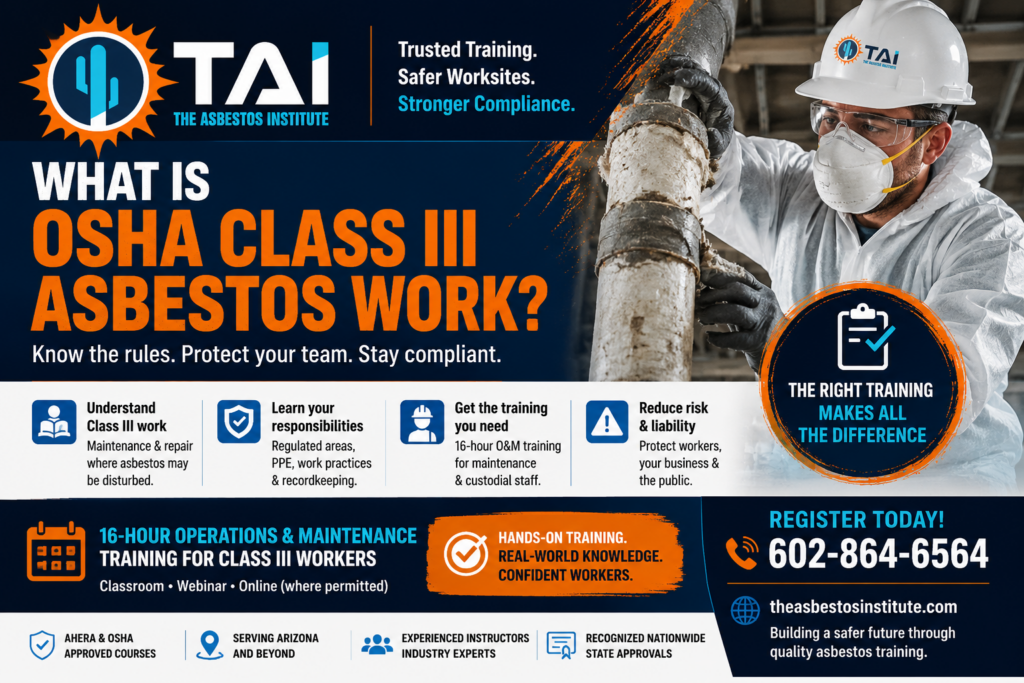
For Class III work that fits the operations and maintenance model, OSHA requires at least sixteen hours of initial instruction, including hands on training. The course must cover applicable work practices and engineering controls for the material the employee will disturb. OSHA allows different activity specific training where the standard operations and maintenance curriculum is not relevant.
The Asbestos Institute offers a sixteen hour Operations and Maintenance Initial course for custodial, maintenance and building trade workers who may disturb minor quantities of asbestos containing material during repair work.
A Regulated Area Is Still Required
Class III work is not informal simply because the affected area is small. OSHA requires a regulated area wherever Class III asbestos work is performed. The area must limit access and protect people outside it from airborne asbestos.
Employers must also evaluate exposure and select controls for the task. Wet methods, local containment, glove bags, mini enclosures and suitable cleanup methods may be required. Respiratory protection and protective clothing depend on the material, exposure assessment and work practices. A negative exposure assessment does not remove the regulated area requirement or every other control.
The Competent Person Has a Real Role
The employer must designate a competent person for asbestos construction work. For Class III activities, that person needs training appropriate to the work and must understand asbestos identification, wet methods, containment methods and ways to reduce exposure.
The competent person should review the task before anyone starts. That includes confirming the material information, deciding how the area will be controlled, checking worker training and making sure the planned method matches the actual condition found on site. When the scope changes, the plan should change with it.
Plan Training Around the Tasks Employees Perform
Job titles are a poor way to choose asbestos training. Two maintenance employees may have completely different exposure potential. One changes filters and cleans floors. The other opens walls, repairs pipe insulation and replaces damaged building materials.
List the tasks each employee performs, identify which materials may be disturbed and then match the training to that work. Contractors should also check state and local requirements because approval rules can be more specific than the federal minimum.
Choose the Right Operations and Maintenance Course
The Asbestos Institute provides OSHA Class III Operations and Maintenance initial and refresher training in Phoenix, with additional course options for employers and individual students. To confirm whether your maintenance or repair work requires Class III training, call 602 864 6564 and discuss the task, location and certification history before enrolling.
Live References
OSHA Asbestos Construction Standard
OSHA Class III Asbestos Training Interpretation
OSHA Class III Regulated Area Guidance
The Asbestos Institute Operations and Maintenance Initial Course